Proudly serving Phoenix, Scottsdale, Glendale, Mesa, Tempe, Chandler & surrounding areasCall or Text 24/7: 602-449-8063
Aerial view of a residential neighborhood with Saguaro cacti and stucco homes in Phoenix, AZ under a clear morning sky.

Pool Chemical Service, Water Testing & Balancing in Phoenix, AZ

Phoenix Expert Pool Service provides pool chemical service, weekly pool maintenance, and water testing for residential and commercial pools in Phoenix. Our technicians balance pH, total alkalinity, free chlorine, calcium hardness, and cyanuric acid with digital reagent testing. We also handle green pool cleanup, acid washing, chemical startups, and saltwater system care when water needs more than a routine adjustment.

Phoenix summers can push pool water past 90 degrees for months, while more than 300 days of direct sun a year speed chlorine loss. Sonoran Desert dust and naturally hard, alkaline source water add pressure from fine particles and mineral buildup. A measured chemical program helps prevent algae, cloudy water, scale, and damage to plaster, tile, and equipment.

Every visit uses commercial-grade treatment products and water-balance guidelines consistent with Certified Pool Operator standards from the Pool & Hot Tub Alliance. We log the readings to build a useful chemistry history instead of relying on a quick visual guess.

Phoenix Expert Pool Service provides pool chemical service in Phoenix, Scottsdale, Tempe, Mesa, Chandler, Glendale, and the greater Phoenix metro area.

★ ★ ★ ★ ★4.9/5 Average Rating · 20+ Years of Experience · Thousands of Customers Helped · Licensed & Insured · Residential & Commercial

Pool Chemical Service Options & Benefits

What Is Pool Chemical Service?

Pool chemical service is the ongoing testing, balancing, and dosing that keeps water sanitized and clear while protecting plaster, tile, and equipment. It is distinct from skimming and vacuuming, although both are included in most full weekly service visits.

Low chlorine leaves room for bacteria and algae, while high pH can reduce chlorine's sanitizing power by as much as 50%. We test five to seven parameters per visit and use the results to correct water in the right sequence.

Phoenix pools do not have a true chemistry off-season. Water temperatures above 85 degrees accelerate algae growth, UV exposure consumes unstabilized chlorine within hours, and seasonal dosing needs to change as stabilizer and minerals accumulate.

Benefits of Professional Chemical Care

Consistent testing and calculated dosing help the sanitizer, surface, and circulation equipment work together. The result is a pool that is easier to keep clear and less likely to require a disruptive correction.

  • Maintain an effective free-chlorine residual
  • Reduce algae and bacteria before they establish
  • Limit scale on tile, plumbing, and equipment
  • Protect plaster and pebble finishes from poor balance
  • Track readings in a documented chemistry history
  • Adjust dosing for heat, sun, dust, and bather load
  • Match treatment to the pool surface and equipment
  • Catch circulation or filter issues affecting water quality
Phoenix Pool Chemistry Services

Complete Pool Chemical Services

A good reading today is only useful if the water remains controlled between visits. We pair precise chemistry with cleaning and equipment observation, then adjust the service level for established pools, problem water, new plaster, and saltwater systems.

Pool Chemical Balancing

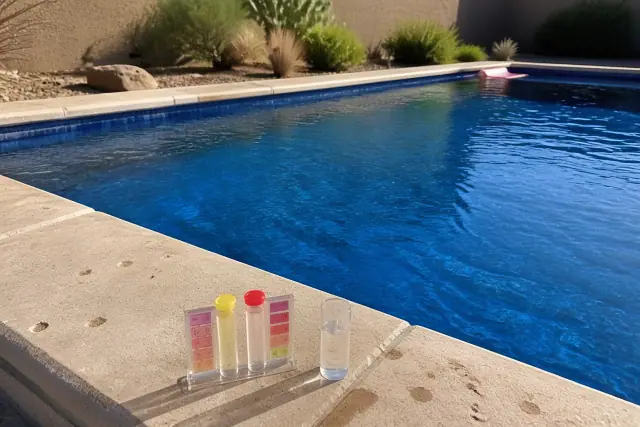
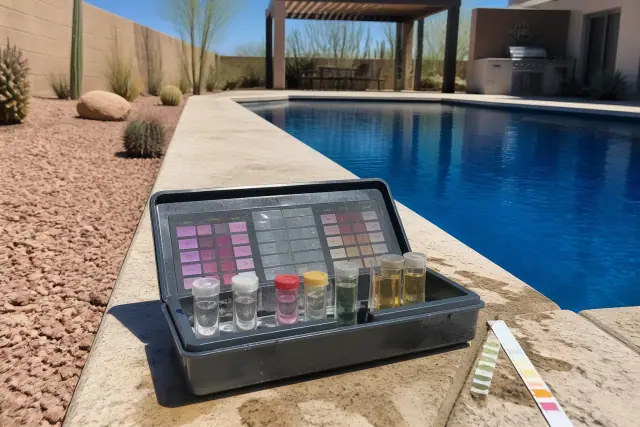
Pool chemical testing kit and vial on a pool deck during a service visit in Phoenix, AZ.

Balanced water begins with alkalinity and pH, then moves to sanitizer, calcium hardness, and cyanuric acid. We account for Phoenix's hard, alkaline tap water and use the pool's actual gallon volume to calculate additions.

Request Estimate

Weekly Pool Maintenance

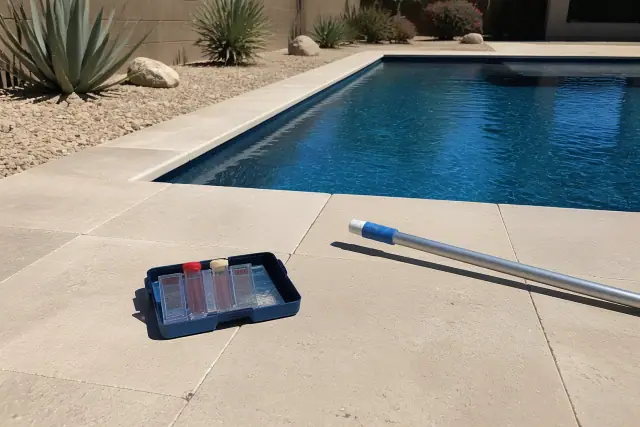
Pool maintenance equipment on a deck beside a rectangular swimming pool in a residential backyard in Phoenix, AZ.

A typical weekly visit takes 60 to 90 minutes for skimming, vacuuming, brushing, testing, and chemical adjustment. Larger pools, heavy bather loads, and pools near mesquite or palo verde trees may benefit from biweekly visits during the middle of the season.

Request Estimate

Green Pool Cleanup

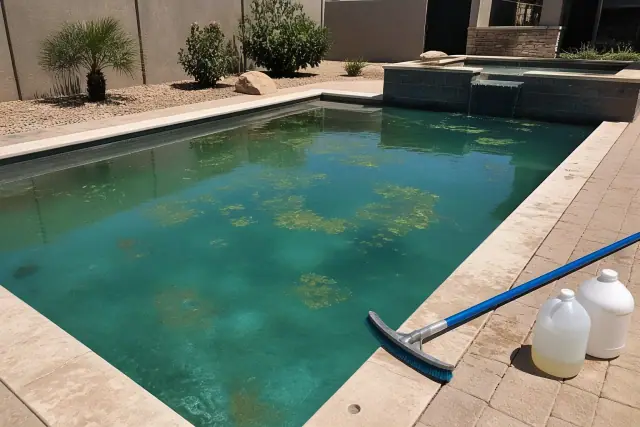
A technician performing green pool cleanup in Phoenix, AZ, with algae-filled water, cleaning tools, and desert landscaping.

We test whether green water comes from algae or dissolved metals before choosing a treatment. Algae cleanup may use shock at three to five times normal levels, continuous filtration, daily brushing, and clarifier or flocculant; full cleanup typically takes two to five days, with many Phoenix pools clearing in 48 to 72 hours once chlorine demand is met.

Request Estimate

Pool Acid Washing

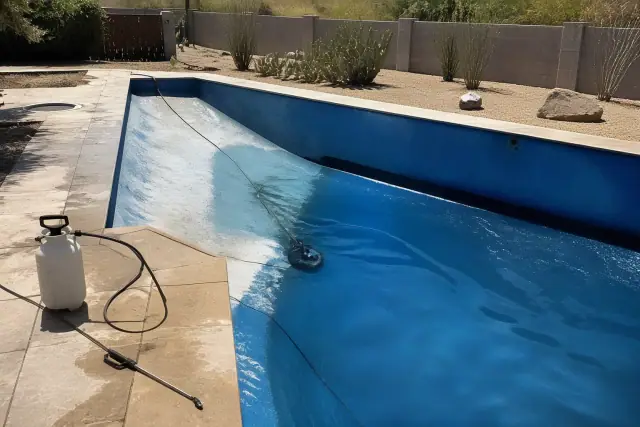
Pool acid washing in progress on a rectangular swimming pool in Phoenix, AZ, with industrial spray gear and wet plaster.

Acid washing addresses heavy calcium scale, mineral staining, and persistent algae staining that brushing cannot remove. It is not annual maintenance: most plaster pools need it every five to seven years, and the runoff is neutralized before drainage in line with Maricopa County Environmental Services Department requirements.

Request Estimate

New Pool Chemical Startup

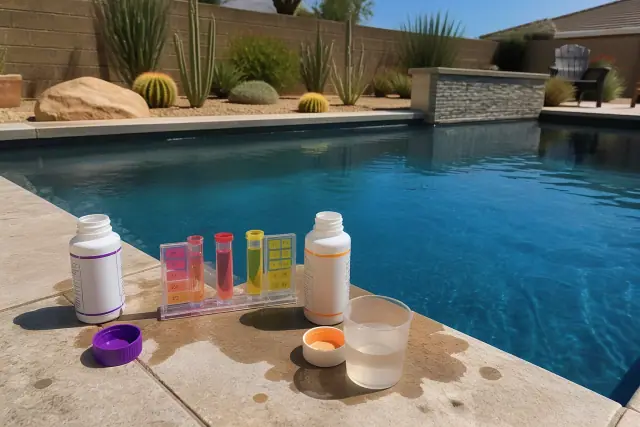
Pool chemical service in progress with test kit and supplies on a poolside deck in Phoenix, AZ.

New plaster needs gradual chemical introduction and controlled brushing during its first 30 days. Many pools reach stable, swimmable chemistry within one to two weeks, while full plaster cure takes closer to 28 days and may call for twice-weekly check-ins during the startup window.

Request Estimate

Professional Pool Water Testing

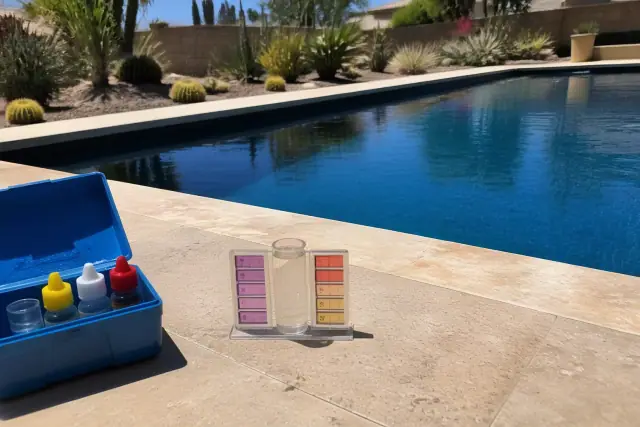
Handheld water chemistry test kit and vials on a poolside deck at a home in Phoenix, AZ.

Digital photometers and liquid reagent kits measure free and combined chlorine, pH, total alkalinity, calcium hardness, cyanuric acid, and total dissolved solids. A full seasonal panel each quarter helps reveal gradual calcium and TDS buildup before peak heat makes the pool harder to balance.

Request Estimate
Pool Chemistry Options

Types of Pool Chemical Treatment

No single product can correct every pool condition. We select sanitizer, balance adjusters, stabilizer, cleanup products, and salt-system care according to the test results, surface, equipment, season, and actual water volume.

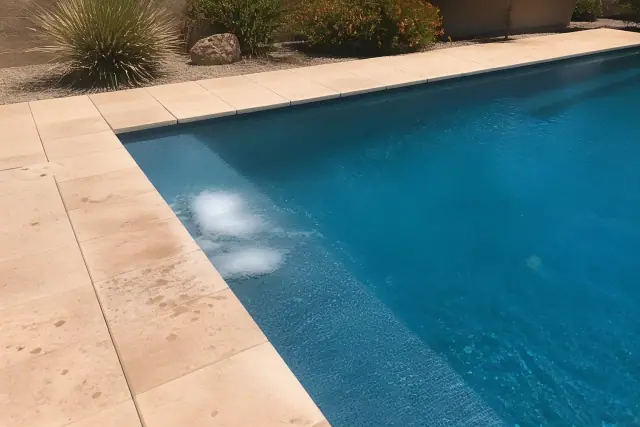
Pool shock treatment chemicals dissolving in a rectangular swimming pool at a residential backyard in Phoenix, AZ.

Chlorine and Shock Treatment

Liquid sodium hypochlorite handles routine dosing, while cal-hypo granular shock is reserved for algae or bather-load spikes. Treatment aims to maintain sanitation without steadily adding stabilizer through heavy trichlor-puck use.

  • Liquid sodium hypochlorite for routine dosing
  • Cal-hypo shock for algae or bather-load spikes
  • Residential free chlorine maintained between 1 and 3 ppm
  • Combined chlorine monitored to limit chloramine buildup
  • Trichlor pucks avoided as the primary sanitizer
Request Estimate
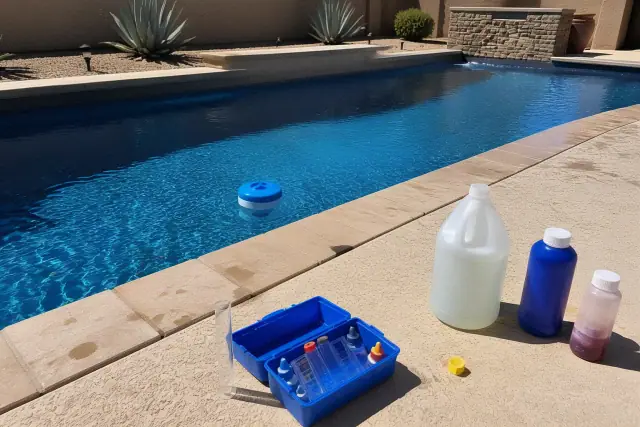
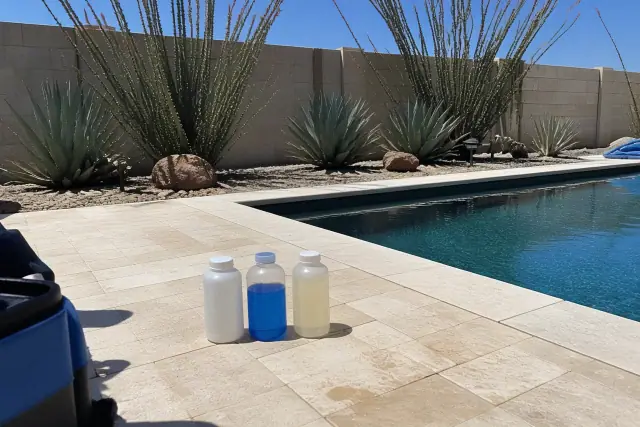
Pool water test kit and chemical bottles on a backyard deck during a pool service in Phoenix, AZ.

pH and Alkalinity Adjustments

Alkalinity buffers pH, so it is corrected first when both values are out of range. Phoenix's naturally alkaline fill water often requires regular acid additions, calculated for the individual pool rather than applied as a flat dose.

  • Target pH between 7.4 and 7.6
  • Target total alkalinity between 80 and 120 ppm
  • Adjust alkalinity before correcting pH
  • Use muriatic acid or dry acid to lower readings
  • Use sodium bicarbonate to raise alkalinity
Request Estimate
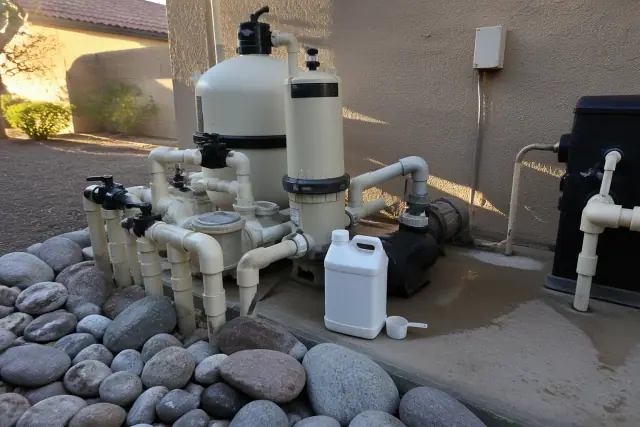
Cyanuric acid additive near pool pumps and filtration equipment at a job site in Phoenix, AZ.

Cyanuric Acid Control

Cyanuric acid shields chlorine from rapid UV degradation, but excessive stabilizer reduces chlorine efficiency. The program balances sun protection with the need to avoid over-stabilized water and chlorine lock.

  • Maintain cyanuric acid between 30 and 50 ppm
  • Protect chlorine from intense Phoenix sunlight
  • Limit unnecessary stabilizer additions
  • Recommend partial drain and refill when a reading reaches 80 ppm
  • Adjust the plan as levels build over summer
Request Estimate
Pool chemicals sitting on a deck by a backyard swimming pool with desert landscaping in Phoenix, AZ.

Algaecides, Clarifiers, and Flocculants

These products solve different problems and are used selectively. Algaecide supports algae control, while clarifiers and flocculants gather fine particles so filtration or vacuuming can restore clarity after an algae treatment or heavy dust runoff.

  • Broad-spectrum algaecide after chlorine demand stabilizes
  • Selective use to avoid unnecessary foaming
  • Clarifier for fine suspended particles
  • Flocculant for coagulation and vacuum removal
  • Useful after green-pool treatment or summer haboob runoff
Request Estimate
Testing vial with pool water and chemical reagents on a pool deck in Phoenix, AZ.

Saltwater Pool Chemistry

Saltwater pools still use chlorine, but the salt cell produces it on site. Hard Phoenix water can scale the cell plates, so chemistry service combines ordinary water balance with closer attention to cell output, salt level, and cleaning needs.

  • Salt concentration typically kept between 2,700 and 3,400 ppm
  • Cell output checked during ongoing service
  • Scale buildup inspected on cell plates
  • pH, alkalinity, and calcium balanced normally
  • Manufacturer salt range used for the installed cell
Request Estimate
Finding Your Right Fit

Choosing the Right Chemical Service Approach

The right plan depends on pool size, finish, equipment, use, tree cover, and whether the owner wants chemical-only or full weekly care. Testing establishes the current condition, and recurring readings show whether the pool needs routine adjustments or a targeted correction.

Digital Testing and Logged Readings

Digital photometers and liquid reagents provide a more complete picture than wide-range dip strips. Logged readings make gradual movement in calcium, stabilizer, and total dissolved solids easier to recognize.

Phoenix Seasonal Adjustments

From May through September, 110-degree days increase water loss and chemical demand, with extra chlorine coverage often needed in July and August. Cooler-season care shifts more attention to the calcium and TDS left concentrated after summer evaporation.

Pool-Specific Chemical Programs

Plaster, pebble finishes, and saltwater systems do not all respond to the same treatment sequence. Dosing is matched to the actual surface and equipment so chemistry supports the pool rather than creating a new scale, corrosion, or cell-output problem.

What Sets Us Apart

Why Choose Us for Pool Chemical Service?

Phoenix Expert Pool Service tests before treating, explains what the readings mean for the specific pool, and checks circulation equipment that can undermine otherwise accurate dosing. The approach combines documented chemistry, seasonal adjustments, and products selected for the job instead of a one-size-fits-all dose.

Request Pool Assessment

Heat and UV Chlorine Loss

Intense sun degrades unstabilized chlorine quickly, and hot water increases sanitizer demand. Without seasonal adjustments, a reading that looked acceptable can fall too low before the next visit.

Algae Growth

Algae commonly follows chlorine dropping to zero, a failed pump, or phosphate input from fertilizer runoff and decaying leaves. Rough or scaled steps and tile lines provide early anchor points, which is why brushing accompanies sanitizer control.

Cloudy Water

Low chlorine, high pH, poor filtration, or particles too fine for the filter can all make water cloudy. Testing identifies whether the answer is chemical correction, continuous filtration, clarifier, flocculant, or an equipment fix.

Calcium Scale and Staining

Phoenix municipal water often starts above 250 ppm calcium hardness, and evaporation concentrates those minerals further. The result may be a rough waterline, scaled equipment, or staining that eventually requires more than routine brushing.

Excess Stabilizer

Repeated use of stabilized chlorine can push cyanuric acid high enough that chlorine no longer works efficiently. Continuing to add sanitizer without correcting the stabilizer level wastes chemical and leaves the underlying problem in place.

Equipment Performance Issues

Short pump cycles, a debris-loaded filter, or a scaled salt cell can undo careful dosing. Checking pump pressure, filter condition, and chlorinator or cell output helps separate a chemical imbalance from a circulation problem.

How it works

Our Pool Chemical Service Process

Each visit follows a test-first sequence so one adjustment does not undermine the next. The process covers the water, pool surface, and circulation equipment, then records the result for the next service decision.

01.

Test the Full Water Panel

Digital and reagent testing establishes free and combined chlorine, pH, alkalinity, calcium hardness, cyanuric acid, and total dissolved solids as needed. Treatment begins with measured conditions rather than the water's appearance alone.

02.

Review the Pool and Equipment

The technician considers gallon volume, finish, bather load, debris exposure, pump pressure, filter condition, and chlorinator or salt-cell output. These details determine whether chemistry alone can correct the condition.

03.

Correct Alkalinity and pH

Alkalinity is adjusted first because it buffers pH. Once that foundation is stable, calculated acid or sodium bicarbonate additions move the water toward the target ranges without creating another swing.

04.

Set Sanitizer and Stabilizer

Chlorine demand and cyanuric acid are adjusted for sun exposure, water temperature, recent use, and the installed sanitation system. Shock or supplemental products are added only when the readings and pool condition support them.

05.

Clean Surfaces and Check Circulation

Skimming, vacuuming, and brushing remove debris and disrupt algae on steps, walls, and tile lines. Pump, filter, basket, chlorinator, and salt-cell observations confirm that treated water can circulate effectively.

06.

Log Results and Plan the Next Visit

Readings and adjustments are recorded to show how the pool changes over time. The history guides seasonal dosing, follow-up testing, partial-drain planning, and repair recommendations when equipment is affecting water quality.

Take Control of Your Pool Water

Schedule a Pool Chemical Service Consultation

Request an assessment for recurring cloudy water, algae, scale, startup chemistry, or ongoing weekly care. Phoenix Expert Pool Service will test the water, review the pool and equipment, and explain the treatment approach supported by the readings.

Pool Chemical Service Help

Phoenix Pool Chemical Service FAQs

These answers cover service frequency, cost, problem-water treatment, chemical ranges, startups, and saltwater care for Phoenix pools. The correct recommendation still begins with current test results and the pool's surface and equipment.

Call Our Experts

Most residential pools do well with weekly service, especially during summer or with frequent swimming, heavy tree cover, or a saltwater system. Some lower-use pools can move to biweekly service in cooler months, but long gaps are a common reason green-water problems develop.

Chemical-only service typically runs $50 to $100 per month. Full weekly service with chemicals, cleaning, and equipment checks generally runs $80 to $150 per month across the Valley, with many Phoenix homeowners paying $115 to $140; one-time green-pool cleanup or acid washing usually runs $150 to $300 depending on severity.

Cloudy water commonly comes from low chlorine, high pH, poor filtration, or particles too fine for the filter to catch. After testing, treatment may combine chlorine and pH correction, continuous filtration, and clarifier or flocculant; many pools clear within 24 to 48 hours once the imbalance is corrected and the full volume has circulated.

A green pool cleanup typically takes two to five days, depending on how long the water was neglected and how much organic material accumulated. The filter runs continuously, surfaces are brushed daily, and chlorine demand is retested until it stabilizes.

Routine balancing and brushing handle ordinary algae and light scale. An acid wash becomes appropriate when calcium deposits, black or green algae staining, or mineral discoloration has bonded to plaster or pebble and no longer responds to normal cleaning.

A standard visit includes water testing and chemical adjustment, surface skimming, floor vacuuming, wall and tile-line brushing, and emptying skimmer and pump baskets. The technician also checks pump, filter, and sanitation equipment performance and logs the chemical readings.

Direct sun and summer water temperatures above 90 degrees accelerate chlorine loss and algae growth. Phoenix fill water also begins high in calcium and alkalinity, while evaporation concentrates dissolved minerals and total dissolved solids over the season.

A saltwater pool still uses chlorine, but a salt cell generates it on site. pH, alkalinity, and calcium are balanced in the usual way, while the service also monitors salt concentration, cell output, and hard-water scale on the plates.

The target pH range is 7.4 to 7.6, with total alkalinity between 80 and 120 ppm. Alkalinity is adjusted first because it buffers pH and helps prevent rapid swings after correction.

Cyanuric acid is generally maintained between 30 and 50 ppm so it protects chlorine from UV loss without over-stabilizing the water. When a reading reaches 80 ppm, a partial drain and refill may be needed before chlorine can work efficiently again.

Many new pools reach stable, swimmable chemistry in one to two weeks, but fresh plaster takes closer to 28 days to cure fully. Chemicals are introduced gradually during the first 30 days, with closer testing because new water and plaster can change quickly.

A professional panel can measure free chlorine, combined chlorine, pH, total alkalinity, calcium hardness, cyanuric acid, and total dissolved solids. Digital photometers and liquid reagents provide the detail needed to connect a reading with the pool's surface, equipment, and recent water conditions.

Each visit includes a check of pump pressure, filter condition, and chlorinator or salt-cell output because poor circulation can make accurate dosing ineffective. If equipment is causing the imbalance, the repair and chemical correction need to be addressed together.