Proudly serving Phoenix, Scottsdale, Glendale, Mesa, Tempe, Chandler & surrounding areasCall or Text 24/7: 602-449-8063
Aerial view of a residential neighborhood with Saguaro cacti and stucco homes in Phoenix, AZ under a clear morning sky.

Pool Pump Repair, Motor Replacement & Seal Service in Phoenix, AZ

Phoenix Expert Pool Service provides pool pump repair, pool equipment repair, and weekly pool service across Phoenix and the Valley. We also handle pool filter cleaning, green pool cleanup, acid washing, and pool tile cleaning. Our technicians work on above-ground and inground pumps, including single-speed, dual-speed, variable-speed, and salt water systems.

Phoenix summers can push ambient temperatures past 110 degrees while pumps run 8 to 12 hours a day, accelerating wear on bearings, seals, and capacitors. We diagnose pressure, flow, amperage, and impeller condition before recommending repair. Technicians are trained on current National Electrical Code requirements for wet-location equipment and follow Arizona Registrar of Contractors licensing standards for residential and commercial pool work. That measured approach helps separate a pump failure from a filter, valve, plumbing, or control problem.

We prioritize same-day and next-day scheduling for pump failures, particularly for weekly pool service and maintenance customers, and can pair pump repair with green pool cleanup when circulation loss has already affected the water.

Phoenix Expert Pool Service provides pool pump repair throughout Phoenix, Tempe, Scottsdale, Glendale, Mesa, and greater Maricopa County.

★ ★ ★ ★ ★4.9/5 Average Rating · 20+ Years of Experience · Thousands of Customers Helped · Licensed & Insured · Residential & Commercial

Pool Pump Repair Options & Benefits

What Does Pool Pump Repair Include?

Pool pump repair starts with finding the source of noise, weak flow, leaks, hard starts, or nonstop operation. The inspection covers the pump wet end, motor, electrical supply, controls, valves, and filter conditions that can imitate pump failure.

Depending on the test results, service may involve bearings, capacitors, mechanical seals, o-rings, gaskets, impellers, diffusers, wiring connections, relays, or time clocks. A small seal leak or worn bearing can often be corrected before water reaches the windings or the motor shaft locks.

When repair is no longer economical, we compare the pump's age, repair history, efficiency, plumbing, automation, and electrical requirements against replacement choices. New installations are checked for prime, pressure, and amperage draw before the work is complete.

Benefits of Accurate Pool Pump Repair

Testing the complete circulation and electrical system helps target the actual fault instead of swapping parts based on symptoms alone. Timely repairs can restore flow, protect the motor, reduce water loss, and give you a clear basis for choosing repair or replacement.

  • Pressure, flow, voltage, and amperage readings identify the root problem
  • Early seal service can keep water away from motor windings
  • Matched-tolerance bearings support a longer-lasting motor repair
  • Relay, time clock, and controller checks prevent unnecessary motor replacement
  • Impeller inspection can restore flow restricted by palm debris or monsoon dust
  • Right-sized replacement avoids wasted energy and plumbing stress
  • Variable-speed settings match filtration, cleaning, and spa modes
  • Final prime, pressure, and amperage testing verifies system operation
Pump Repair Services

Phoenix Pool Pump Repair Services

Our pump work covers motor components, leaking seals, hydraulic restrictions, electrical faults, efficiency upgrades, and full replacement. Each recommendation follows system testing so the proposed work fits the condition of the pump and the rest of the equipment pad.

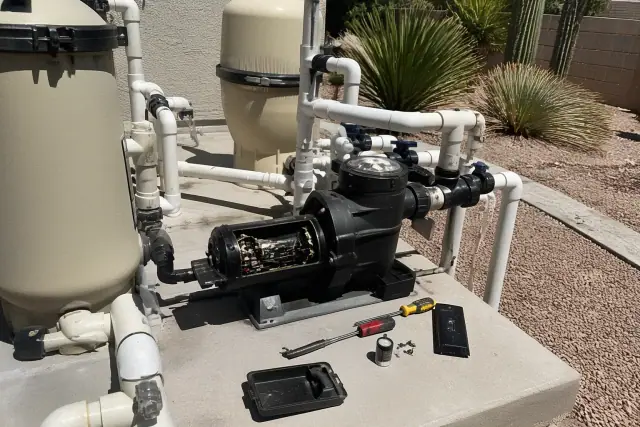
Pool Pump Motor Repair

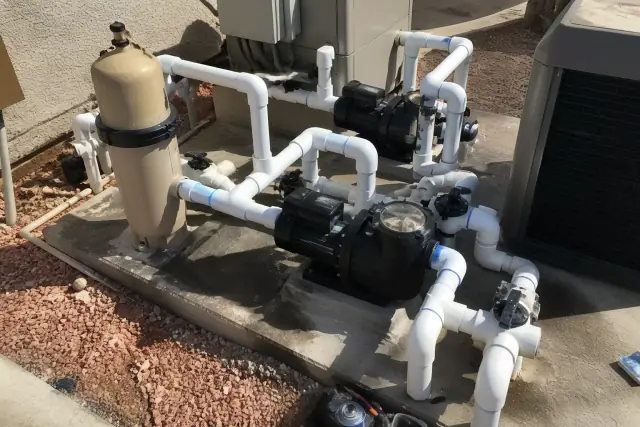
Pool pump motor repair on a concrete slab in Phoenix, AZ, showing internal wiring and filtration equipment.

Motor service can include matched-tolerance bearing replacement, seal and gasket replacement, winding resistance tests, rewind evaluation, and capacitor testing. Even a motor rated for 3,450 RPM continuous duty can overheat when Phoenix equipment-pad temperatures remain near 115 degrees for months.

Request Estimate

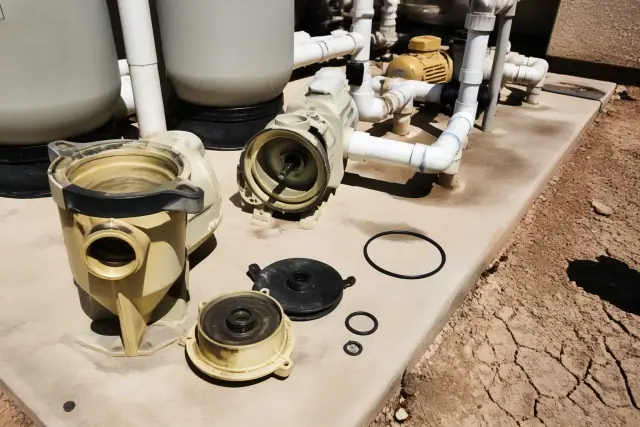
Pump Seal and Gasket Replacement

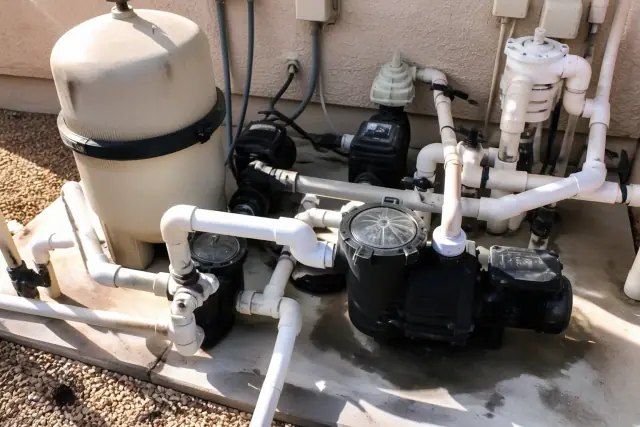
Pool pump seal and gasket replacement in progress on a concrete equipment pad in Phoenix, AZ.

We inspect the mechanical seal, shaft sleeve, lid o-ring, union gaskets, and drain plug seals for wear, grooving, corrosion, UV damage, and chlorine exposure. Catching a $30 to $80 seal-kit problem early can help prevent the water intrusion that may lead to a $400 motor rebuild.

Request Estimate

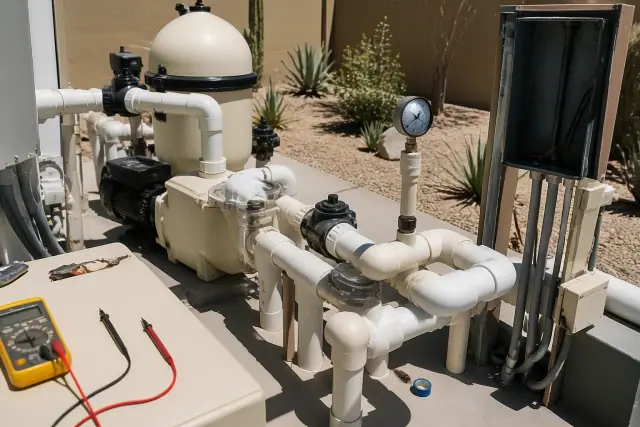
Pressure, Flow, and Electrical Diagnostics

Pool pump system diagnostic work with multimeter and pressure gauge on a concrete slab in Phoenix, AZ.

We compare filter inlet and outlet pressure with the baseline for the installed cartridge or sand filter, then test flow, voltage, and motor amperage. A pressure differential 8 to 10 PSI above baseline often points to a restriction elsewhere in the system rather than pump failure.

Request Estimate

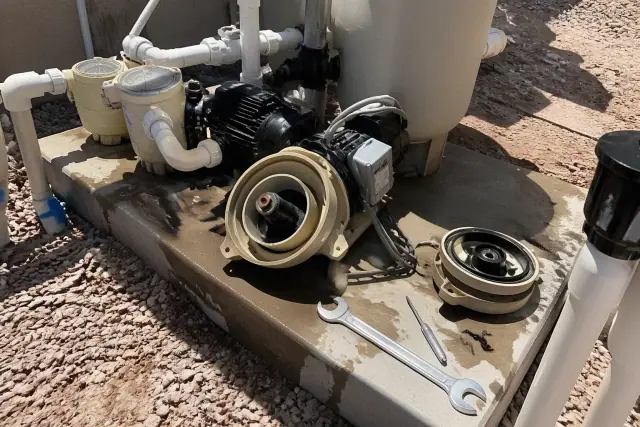
Impeller and Circulation Repair

Pool pump impeller repair with tools and exposed plumbing on a concrete equipment pad in Phoenix, AZ.

Weak returns, cloudy water, and poor skimmer pull can result from a clogged impeller, cracked diffuser, failing check valve, loose union, or air leak. We open the housing as needed to check for debris and wear, including palm material and monsoon dust that commonly restrict Phoenix pool circulation.

Request Estimate

Variable-Speed Pump Conversion

Variable-speed pool pump conversion with new PVC plumbing on a concrete slab in Phoenix, AZ.

Before recommending a variable-speed conversion, we check pipe sizing, automation controls, electrical requirements, pump horsepower, and current run time. These pumps can reduce electricity consumption by up to 90 percent compared with older single-speed pumps, and many Phoenix homeowners recover the price difference through lower Salt River Project or Arizona Public Service bills within two to four years.

Request Estimate

Pool Pump Replacement

New pool pump with PVC fittings on a concrete filtration pad at a home in Phoenix, AZ.

Replacement becomes a stronger option when a pump is pushing 10 to 12 years old or repair costs climb past $600 to $800. We size the new pump to pool gallonage, plumbing, heaters, water features, and turnover needs, then complete the electrical connections, plumbing adaptation, pad mounting, testing, and old-equipment disposal.

Request Estimate
Pump Configurations

Pool Pump Types We Service

Phoenix pools use several pump configurations, and each has different controls, flow demands, and repair considerations. We service single-speed, dual-speed, variable-speed, above-ground, inground, and salt water pool pump systems.

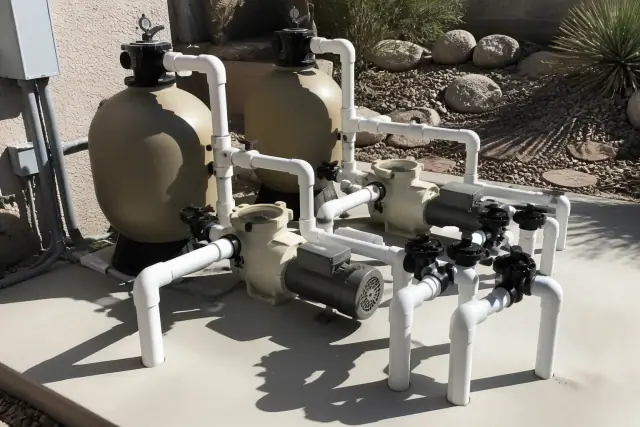
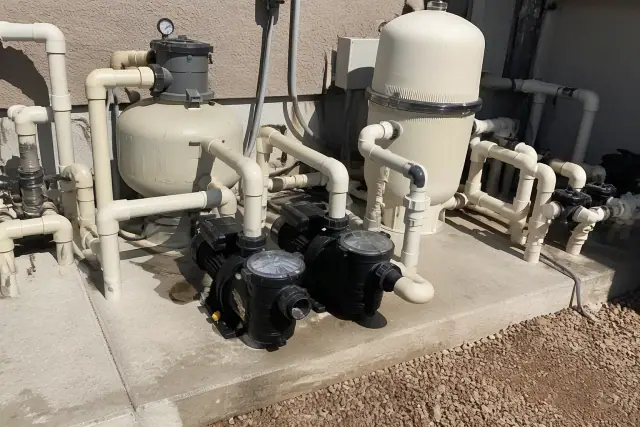
Single-speed pool pump installation with filtration tanks and plumbing on a concrete slab in Phoenix, AZ.

Single-Speed Pool Pumps

Single-speed pumps run at full RPM for every cycle, which increases energy use and places continuous load on motor components. Diagnostics focus on whether bearings, capacitors, seals, the impeller, or electrical supply can be repaired economically.

  • Bearing noise and shaft condition
  • Start and run capacitor testing
  • Mechanical seal and motor-end inspection
  • Impeller and diffuser condition
  • Repair cost compared with variable-speed replacement
Request Estimate
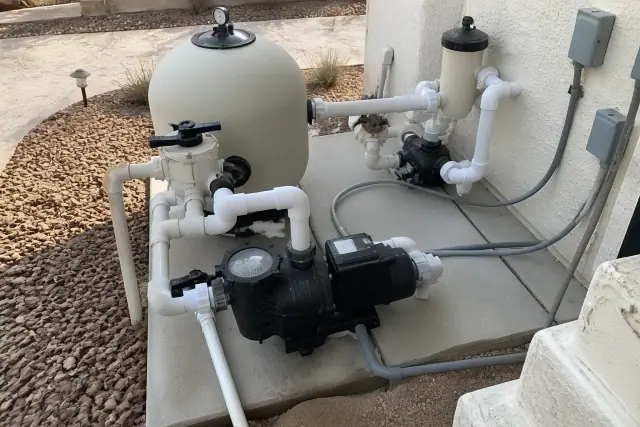
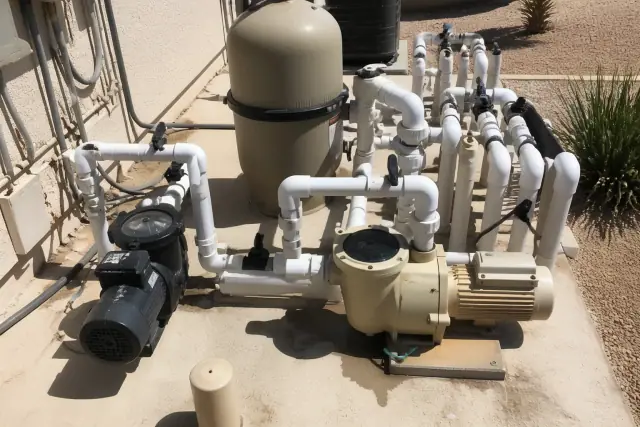
Dual-speed pool pump installed on a concrete slab with plumbing and desert landscaping in Phoenix, AZ.

Dual-Speed Pool Pumps

Dual-speed pumps use separate low- and high-speed operation for routine filtration and higher-flow tasks. We test both speed circuits and controls so a switching fault is not mistaken for a failed motor.

  • Low-speed and high-speed circuit checks
  • Relay and time clock testing
  • Motor load and amperage comparison
  • Flow verification at each operating speed
  • Seal, gasket, and housing inspection
Request Estimate
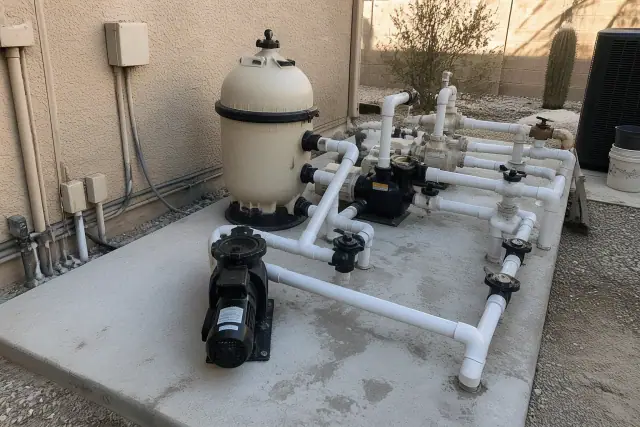
Variable-speed pool pumps and filtration equipment on a concrete slab at a jobsite in Phoenix, AZ.

Variable-Speed Pool Pumps

Variable-speed pumps run at lower RPM for routine filtration and increase speed for spa jets or vacuum cycles. We evaluate controls, programming, plumbing, electrical compatibility, and hydraulic demand when servicing or installing this technology.

  • Multiple speed settings for filtration, cleaning, and spa modes
  • Quieter lower-RPM operation
  • Reduced mechanical stress on bearings and seals
  • Programming based on pool turnover requirements
  • Expected savings reviewed from horsepower and run time
Request Estimate
Pool pump and filtration equipment on a concrete pad at a jobsite in Phoenix, AZ.

Above-Ground and Inground Pool Pumps

Above-ground pumps are typically smaller and use simpler plumbing, while inground systems may serve multiple returns, spa jets, heaters, or water features. We bring the diagnostic approach and parts inventory needed for either configuration.

  • Pump sizing matched to pool gallonage
  • Plumbing size and return-flow evaluation
  • Heater, spa jet, and water-feature demand checks
  • Prime and suction-side air-leak testing
  • Residential and commercial pool equipment service
Request Estimate
Salt water pool pump system with filtration tanks and exposed plumbing on a concrete slab in Phoenix, AZ.

Salt Water Pool Pump Systems

Salt water systems expose metal components and seals to additional corrosion stress from the saline environment and chlorine generator. Diagnostics account for the salt cell, plumbing layout, fittings, seals, and balanced salinity when tracing pump performance problems.

  • Closer inspection of o-rings and mechanical seals
  • Metal fitting and shaft corrosion checks
  • Salt cell placement and plumbing review
  • Pump performance testing with the full system operating
  • Maintenance guidance tied to balanced salinity
Request Estimate
Finding the Right Fix

Choosing the Right Pool Pump Approach

The right solution depends on the failed component, pump age, repair history, energy use, plumbing, and controls. Repair often makes sense when the pump is under roughly seven years old and the fix costs less than half the price of a new unit; older or repeatedly failing equipment deserves a direct comparison with current variable-speed choices.

Measured Pump Diagnostics

We test pressure, flow, incoming voltage, motor amperage, capacitance, impeller condition, and control operation before recommending parts. Measurements help distinguish a failed motor from restrictions, air leaks, undervoltage, or automation wiring faults.

Phoenix Heat and Dust Knowledge

Our diagnostic sequence accounts for extreme ambient heat, hard mineral-heavy water, fine dust, monsoon debris, UV exposure, and long summer run times. Those local conditions can accelerate insulation breakdown, bearing wear, seal degradation, and partial impeller blockage.

Repair-or-Replace Guidance

After diagnostics, we compare repair cost with the pump's age, condition, efficiency, and replacement price. You receive an estimate before work begins, along with a realistic timeframe and the reasoning behind the recommended option.

What Sets Our Work Apart

Why Choose Us for Phoenix Pump Repair?

Phoenix Expert Pool Service evaluates the full circulation and electrical system instead of treating every symptom as a bad motor. Common residential motor components are stocked for faster repairs, while replacement recommendations account for hydraulic fit, controls, code requirements, and actual operating costs.

Request Pump Diagnostics

Pump Noise and Vibration

Grinding, screeching, or a high-pitched whine usually points to worn motor bearings. A rattling equipment pad can also indicate an unlevel mount or debris behind the impeller; delaying a $150 to $300 bearing job can allow the motor shaft to lock and require full motor replacement.

Weak Pool Circulation

Weak return jets, cloudy water, or a skimmer that will not pull debris can signal a clogged impeller, failing check valve, dirty filter, closed valve, or suction-side air leak. Direct flow and pressure testing shows whether the pump or another system component is restricting circulation.

Pump Housing Leaks

Water beneath the housing can come from a failed mechanical seal, cracked diffuser, lid o-ring, union gasket, or drain plug seal. An uncorrected leak can waste hundreds of gallons monthly and damage electrical windings if water reaches the motor housing.

Pump Runs Constantly

A pump that will not shut off often traces to a stuck relay, bad time clock, or automation-controller wiring issue rather than the motor. Checking the control side first avoids replacing a working pump without correcting the fault.

Hard Starts and Breaker Trips

Humming, hard starts, or a tripped breaker can result from a weak start or run capacitor, undervoltage, corroded connections, bearing drag, or a mechanical bind. Capacitance and amperage measurements reveal electrical faults that may not be visible during an inspection.

Heat, Scale, and Debris Wear

Arizona's mineral-heavy municipal water, supplied through Salt River Project and Central Arizona Project systems, contributes scale that wears rubber and ceramic seal faces. Phoenix heat, UV exposure, chlorine contact, fine dust, and palm debris add stress to gaskets, housings, motor insulation, and impellers.

How It Works

Our Pool Pump Repair Process

Every pump call follows a consistent diagnostic sequence, whether the equipment serves a residential backyard pool in Arcadia or a commercial pump station at a Phoenix apartment complex. The process moves from symptoms and system measurements to component inspection, an estimate, repair, and final operating checks.

01.

Review Symptoms and Equipment

We review the noise, leak, flow, starting, or scheduling symptoms and inspect the pump, filter, valves, plumbing unions, controls, and equipment pad. Pump age, repair history, pool configuration, and visible heat or corrosion damage guide the next tests.

02.

Test Pressure and Flow

We gauge filter inlet and outlet pressure, compare readings with the baseline for the filter type, and measure circulation. This step helps locate clogged filters, closed valves, check-valve trouble, suction leaks, and impeller restrictions.

03.

Analyze Voltage and Motor Load

Incoming voltage is checked against the motor rating, connections are inspected for corrosion, and amperage is compared with the nameplate under normal load. Capacitor and winding-resistance tests narrow down hard starts, overheating, breaker trips, and electrical failure.

04.

Inspect the Impeller and Seals

When indicated by the tests, we open the wet end to inspect the impeller, diffuser, mechanical seal, shaft sleeve, o-rings, gaskets, and housing. Parts are checked for blockage, cracks, scale, grooving, corrosion, and water paths toward the motor.

05.

Compare Repair and Replacement

We explain the failed component, the proposed fix, the estimate, and the expected timeframe before work begins. If the pump is older or the repair is substantial, we compare that option with a correctly sized variable-speed replacement rather than defaulting to the higher-cost choice.

06.

Repair, Program, and Test

After the approved repair or installation, we restore the system, program applicable speed settings, and test prime, pressure, flow, and amperage draw. Variable-speed setups are generally programmed toward a full residential water turnover every 8 to 12 hours while accounting for filtration, cleaning, and spa modes.

Restore Pool Circulation

Schedule a Pool Pump Repair
Consultation

Grinding, leaks, weak returns, hard starts, and nonstop operation are signs to have the complete system checked before a small fault causes secondary damage. Request an estimate from Phoenix Expert Pool Service for pump diagnostics, repair, or replacement guidance in Phoenix and the surrounding service area.

Pump Repair Help

Phoenix Pool Pump Repair FAQs

Get clear answers about Phoenix pump lifespan, common failure signs, repair costs, service timeframes, system types, and replacement decisions. The best next step for a specific pump still begins with pressure, flow, electrical, and component testing.

Call Our Pump Experts

Most residential pool pumps last 8 to 12 years nationally, but Phoenix's extended pool season and extreme summer heat tend to push lifespan toward the lower end of that range. Motors often need bearing or seal service between years 5 and 8, and it is sensible to begin a rebuild-or-replacement conversation after the 8-year mark. Weekly service and equipment inspections can catch wear before it causes secondary damage.

Common problems include worn bearings that cause noise, failed mechanical seals that leak, clogged or cracked impellers that restrict flow, and weak capacitors that cause hard starts or breaker trips. Corroded wiring, voltage irregularities, dirty filters, and closed valves can produce similar symptoms. Testing the full system prevents unnecessary parts replacement.

Common Phoenix-area pump repairs typically run $200 to $600 for diagnostics, seal replacement, and minor motor work. Full pump replacement generally runs $800 to $2,800 depending on horsepower and the choice between single-speed and variable-speed technology. Phoenix Expert Pool Service provides an estimate after diagnostics so you can review the cost before work begins.

Straightforward seal, capacitor, or bearing repairs are often completed same-day because common parts for major residential pump brands are stocked. A rewind or special-order component can extend the work to several days, while a full replacement is typically a same-day installation once the new unit is on-site. We explain the expected timeframe after diagnostics.

Repair is usually the stronger financial choice when a pump is under about seven years old and the work is under $600. Once repair cost approaches $800 or the pump reaches the 8 to 10 year range, replacement with a more efficient variable-speed model often makes more sense. The final decision should also account for repair history, plumbing, controls, and energy use.

Above-ground pumps are generally smaller systems with simpler plumbing, so diagnostics and repair can be more direct. Inground pumps may serve multiple returns, spa jets, heaters, or water features and therefore require more hydraulic checks. Both configurations face Phoenix heat, mineral scale, and long run-time stress.

Salt water systems place additional corrosion stress on metal components and seals, even at the lower salinity used with residential chlorine generators. O-rings, mechanical seals, metal fittings, salt cell placement, and plumbing configuration deserve closer inspection. Balanced salinity and regular chemical service help limit extra wear.

Grinding, screeching, vibration, weak returns, cloudy water, poor skimmer pull, water beneath the housing, humming, breaker trips, and nonstop operation all deserve inspection. These symptoms can come from the motor, wet end, filter, valves, plumbing, or controls. Early diagnosis can keep a smaller fault from damaging additional components.

A pump that runs constantly often has a stuck relay, failed time clock, or automation-controller wiring fault rather than a bad motor. Testing the controls first shows whether the pump is simply obeying an incorrect electrical command. Replacing the motor alone would not correct that problem.

A variable-speed pump can reduce electricity consumption by up to 90 percent compared with an older single-speed pump by using lower RPM for routine filtration. Many Phoenix homeowners recover the price difference through lower Salt River Project or Arizona Public Service bills within two to four years. Actual savings depend on current horsepower, run time, plumbing, and programmed speeds.

No. A pressure differential 8 to 10 PSI above the baseline for the filter commonly indicates restricted flow somewhere in the circulation system, not necessarily a failed pump. Comparing inlet and outlet pressure with flow helps locate a dirty filter, closed valve, impeller blockage, or other restriction.

The diagnostic sequence measures pressure, flow, incoming voltage, motor amperage, and capacitor performance, then inspects the impeller, diffuser, seals, gaskets, housing, controls, and wiring. Readings are compared with filter baselines and motor nameplate ratings. That process distinguishes component failure from restrictions, leaks, undervoltage, and automation trouble.

Request service promptly because stagnant water can turn green within days in Phoenix heat once circulation stops. Phoenix Expert Pool Service prioritizes same-day and next-day scheduling for pump failures, especially for customers on weekly service or maintenance plans. If the water has already turned, green pool cleanup can be paired with pump repair.