Proudly serving Phoenix, Scottsdale, Glendale, Mesa, Tempe, Chandler & surrounding areasCall or Text 24/7: 602-449-8063
Aerial view of a residential neighborhood with Saguaro cacti and stucco homes in Phoenix, AZ under a clear morning sky.

Pool Equipment Repair for Pumps, Heaters & Automation in Phoenix, AZ

Phoenix Expert Pool Service repairs pool pumps, filters, heaters, automation controls, valves, chlorinators, and saltwater systems for homeowners and commercial properties in Phoenix, Arizona. We diagnose mechanical, electrical, plumbing, circulation, and heating faults at the equipment pad. Our services include pump and motor repair, filter cleaning, heater repair, plumbing and valve repair, and controller troubleshooting. We also provide weekly pool service, cleaning, chemical service, green pool cleanup, acid washing, and tile cleaning when broader pool care is needed.

Surface temperatures on exposed Phoenix equipment pads routinely climb past 160 degrees, accelerating wear on seals, bearings, and capacitors. Hard, mineral-rich Salt River Valley water can scale impellers, filters, and heater exchangers until flow drops and motors work harder. Pump issues account for roughly 65% of the mechanical equipment failures we see on service calls. Our technicians test the actual component failure, explain repair and replacement options, and provide a written estimate before work begins.

Our technicians hold Certified Pool Operator credentials through the Pool & Hot Tub Alliance and use its testing procedures for motor windings, impeller wear, and plumbing leaks. Call for a free pool repair estimate and an equipment-pad walkthrough before authorizing work.

Phoenix Expert Pool Service provides pool equipment repair across Phoenix, Scottsdale, Tempe, Mesa, Glendale, and the greater Phoenix metropolitan area.

★ ★ ★ ★ ★4.9/5 Average Rating · 20+ Years of Experience · Thousands of Customers Helped · Licensed & Insured · Residential & Commercial

Phoenix Pool Equipment Repair Options & Benefits

What Does Pool Equipment Repair Cover?

Pool equipment repair addresses the pumps, filters, heaters, valves, plumbing, chlorinators, saltwater systems, and automation controls that circulate and treat pool water. It focuses on mechanical, electrical, and hydraulic faults rather than structural deck or plaster work.

Diagnosis may include pressure testing, electrical readings with a multimeter, impeller and seal inspection, controller error review, water testing, and leak detection with dye or listening equipment. The goal is to identify the failed component without unnecessary replacement or excavation.

Repair may involve a motor, capacitor, shaft seal, union, O-ring, valve, thermostat, igniter, heat exchanger, filter element, grid, or control component. We compare equipment age, repair history, part availability, energy use, and installed replacement cost before recommending repair or replacement.

Benefits of Professional Equipment Repair

A focused equipment diagnosis restores the function the pool needs while helping prevent a small seal, flow, or electrical fault from spreading to more expensive components.

  • Restore dependable circulation and filtration
  • Trace motor, impeller, capacitor, and plumbing faults
  • Correct heater, valve, and controller problems
  • Reduce strain caused by scale and restricted flow
  • Compare repair and replacement using equipment condition
  • Review a written estimate before work starts
  • Verify completed repairs with pressure or load testing
  • Account for Phoenix heat, dust, and hard-water conditions
Pool Equipment Repair Services

Pool Equipment Repair Services

We service the equipment that moves, filters, heats, controls, and sanitizes pool water. Each repair begins with the symptoms at the pool and equipment pad, then narrows the problem to the component causing the failure.

Pool Pump and Motor Repair

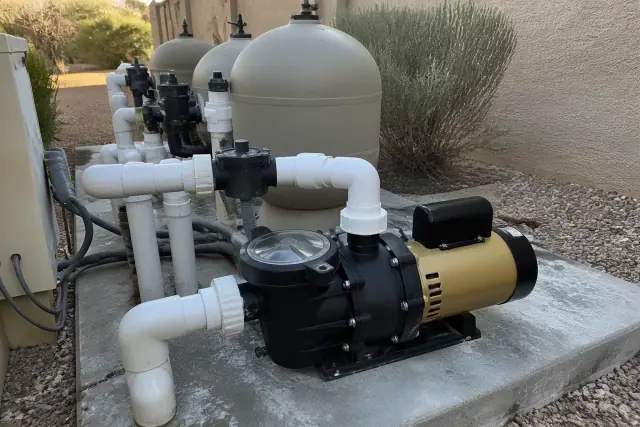
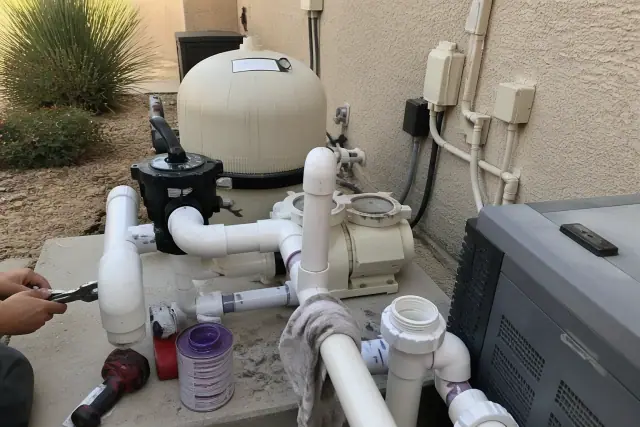
Pool pump and motor repair with new PVC couplings on a concrete equipment pad in Phoenix, AZ.

Grinding, screeching, low return flow, repeated breaker trips, water beneath the housing, or a pump that will not prime can point to bearing, motor, capacitor, shaft-seal, or impeller trouble. We test the pump and circulation path before recommending the affected repair.

Request Estimate

Pool Filter Cleaning and Service

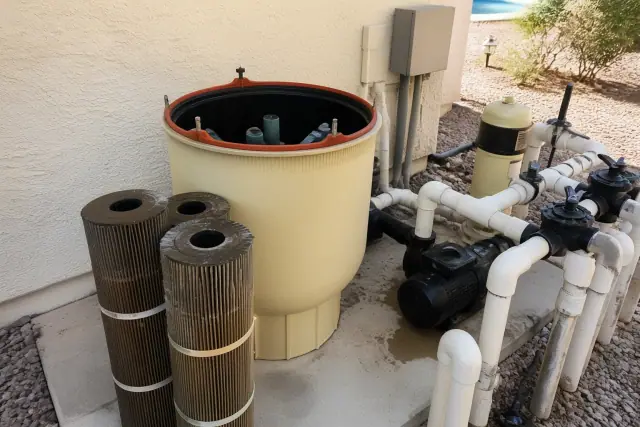
A technician cleaning pool filter cartridges on a concrete slab at a residential property in Phoenix, AZ.

We backwash and deep-clean sand filters, hose and degrease cartridge elements, and clean DE grids before adding a fresh powder charge. Pressure, media condition, torn grids, and restricted flow help determine whether cleaning, media service, or component replacement is appropriate.

Request Estimate

Pool Heater Repair

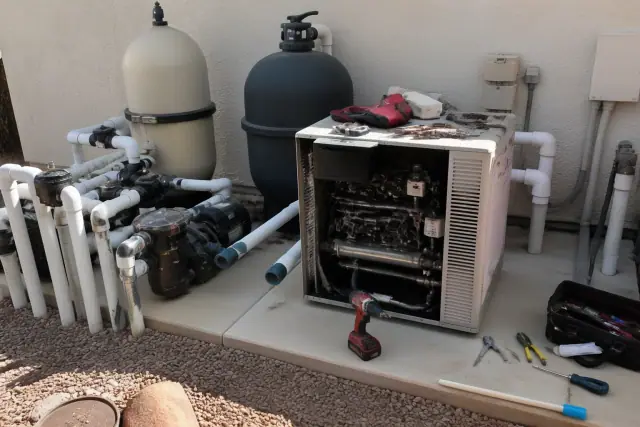
Pool heater repair work in progress on a residential pool system in Phoenix, AZ.

A heater that runs without warming the water, displays error codes, loses its pilot, or makes unusual operating noises needs a component-level check. We examine thermostats, igniters, heat exchangers, controls, and gas-supply symptoms before outlining the repair.

Request Estimate

Pool Plumbing and Valve Repair

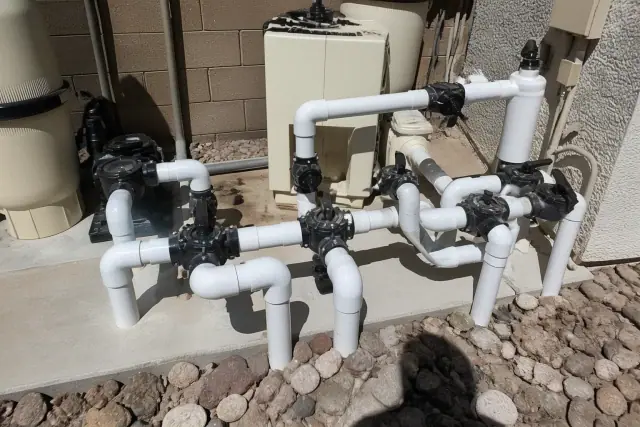
New PVC plumbing and valves on a pool equipment pad at a jobsite in Phoenix, AZ.

Leaks around unions, O-rings, pump housings, and exposed plumbing can lower water levels, introduce air, and make a pump lose prime. We locate the leak, assess cracked fittings and worn seals, and make the needed plumbing or valve repair.

Request Estimate

Pool Automation and Controller Repair

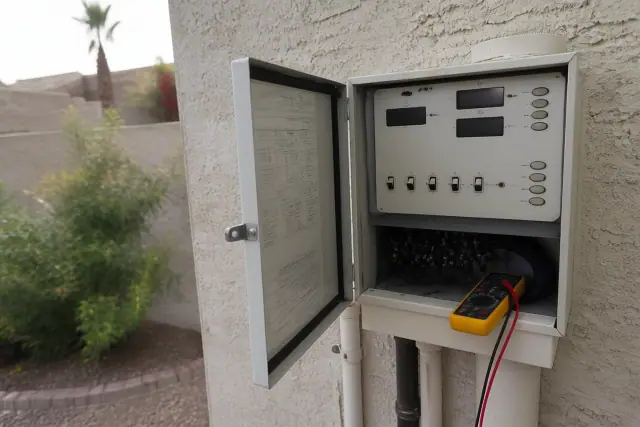
Wall-mounted pool automation controller with a wire tester on a stucco exterior in Phoenix, AZ.

Controller, timer, sensor, and control-board faults can disrupt pump schedules, heating, filtration, and sanitation. We review error behavior, electrical inputs, settings, and connected equipment to distinguish a programming issue from a failed control component.

Request Estimate

Chlorinator and Saltwater System Repair

Technician repairing a saltwater pool system on a concrete pad at a home in Phoenix, AZ.

Chlorinator and saltwater-system faults can leave sanitation inconsistent even when circulation appears normal. We inspect flow, scale, cells, plumbing connections, and control behavior so the repair addresses the source of the dosing problem.

Request Estimate
Equipment Categories

Pool Equipment Types We Repair

Phoenix pools use several equipment configurations, and each category has different wear points, service intervals, and repair decisions. We evaluate the installed system rather than treating every symptom as the same fault.

Pool pumps and filtration system installed on a concrete slab in Phoenix, AZ.

Pool Pumps and Motors

Pump service covers the motor and wet-end components that create circulation. We work on single-speed, two-speed, and variable-speed equipment while checking the hydraulic and electrical conditions around the failure.

  • Single-speed motor and pump diagnostics
  • Two-speed system troubleshooting
  • Variable-speed pump diagnosis and replacement
  • Impeller, bearing, shaft-seal, and basket repair
  • Capacitor, winding, and breaker-trip testing
Request Estimate
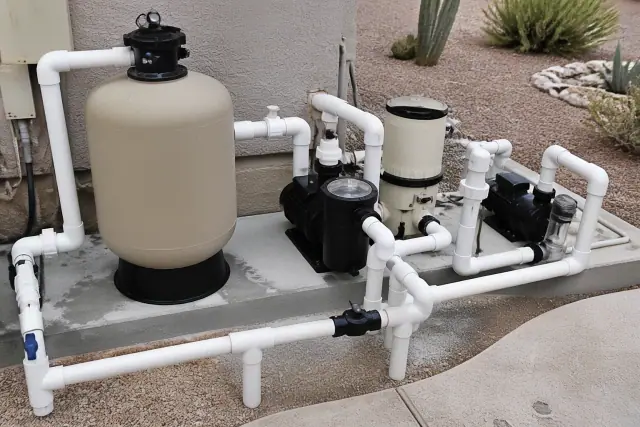
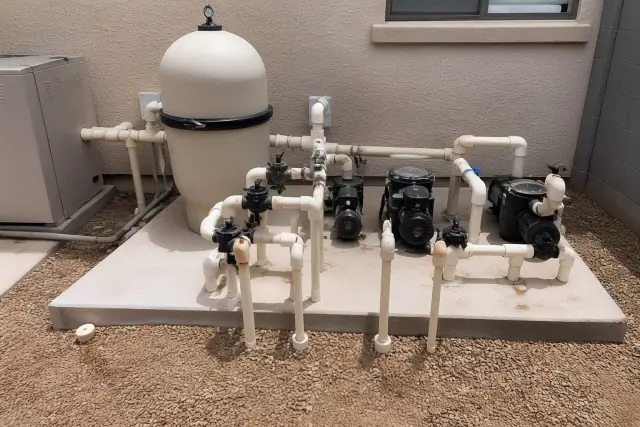
Pool equipment pad in Phoenix, AZ featuring sand, cartridge, and DE pool filters with plumbing and booster pumps.

Sand, Cartridge, and DE Filters

Filter care depends on the media and the debris it has captured. Phoenix dust, pollen, oils, sunscreen residue, calcium, and algae byproduct each call for the right cleaning or replacement decision.

  • Sand-filter backwashing and seasonal deep cleaning
  • Sand media condition and replacement
  • Cartridge degreasing and element replacement
  • Filter pressure, flow, and system-age evaluation
  • DE grid inspection, cleaning, and fresh powder charges
Request Estimate
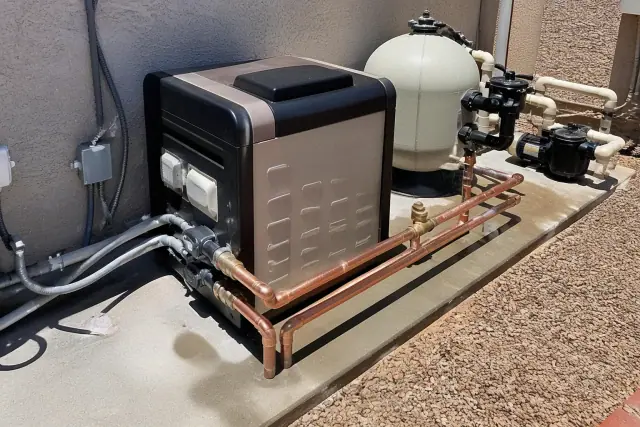
Pool heater and filtration equipment on a concrete slab at a residential worksite in Phoenix, AZ.

Pool Heaters

Heater diagnosis follows the symptom from the control panel through ignition, heat transfer, and water flow. An annual equipment check before winter can reveal trouble before the first cold-weather use.

  • Thermostat and temperature-control faults
  • Igniter, pilot-light, and gas-supply symptoms
  • Dirty or scaled heat exchangers
  • Error-code and control-panel diagnosis
  • Water-flow verification before component replacement
Request Estimate
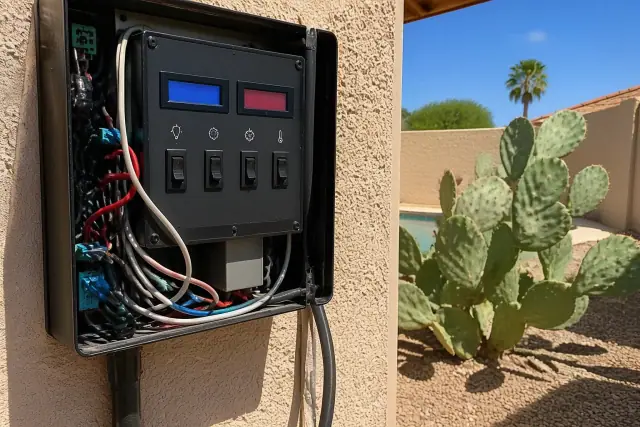
Pool equipment control panel with wires and open housing on a stucco wall in Phoenix, AZ, near prickly pear cactus.

Automation and Controls

Automation coordinates circulation, filtration, heating, and sanitation. We evaluate programming and connected equipment before treating a controller symptom as a failed board.

  • Controller and timer troubleshooting
  • Sensor and control-board diagnosis
  • Pump, heater, and sanitizer communication checks
  • Seasonal run-time programming
  • Winter and monsoon-season schedule adjustments
Request Estimate
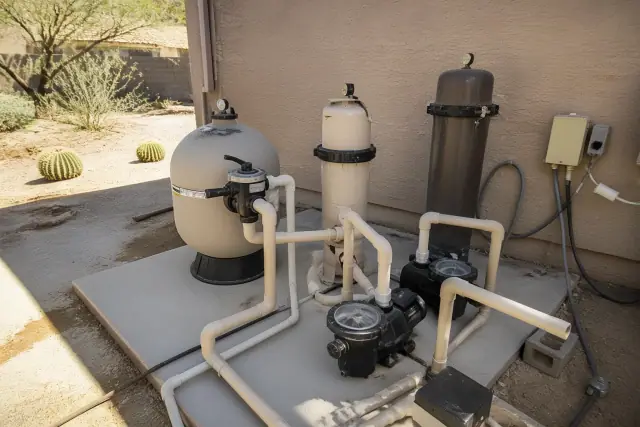
Pool equipment including filtration tanks, pumps, and plumbing lines on a concrete slab in a Phoenix, AZ backyard.

Plumbing, Valves, and Sanitizers

The circulation path also depends on sealed plumbing, operating valves, and reliable sanitizer equipment. We inspect visible connections, flow behavior, and scale before selecting a repair.

  • Cracked union fitting and exposed-plumbing repair
  • Pool valve inspection and repair
  • Chlorinator flow and dosing diagnosis
  • Saltwater cell, scale, and control checks
  • Early $40 O-ring service before damage reaches a $600 pump
Request Estimate
Finding Your Right Fit

Choosing the Right Repair Approach

The right decision depends on the failed part, equipment age, repair history, run time, water chemistry, energy use, part availability, and access to the equipment pad. We explain which factors support a targeted repair and which make replacement the more practical long-term option.

Climate-Aware Equipment Diagnostics

We account for heat cycles, dust, UV exposure, hard-water scale, and changing seasonal demand when diagnosing equipment. Run times, chemical dosing, and filtration needs shift as Phoenix moves through 110-degree summers and mild winters.

Written Repair Estimates

After identifying the failed component, we provide a written estimate before starting work. The recommendation accounts for the required part, motor horsepower, plumbing changes, equipment-pad access, and compatible parts for older systems.

Credentialed Repair Standards

Our technicians hold Certified Pool Operator credentials through the Pool & Hot Tub Alliance and stay current on equipment and controllers used across the valley. We work under Arizona Registrar of Contractors requirements for residential and commercial pool work.

Repair Standards

Why Choose Phoenix Expert Pool Service for Equipment Repair?

We use correctly sized parts, proper fitting torque, fresh gaskets, and pressure testing rather than shortcuts that fail under Phoenix heat cycles. Urgent safety issues, active leaks, and complete equipment failures receive scheduling priority, and same-day appointments may be available when a technician is already working nearby. Call early for availability or request a free pool repair estimate.

Get a Free Repair Estimate

Noisy or Low-Flow Pool Pump

Grinding or screeching, weak return flow, repeated breaker trips, failure to prime, and water beneath the pump housing can indicate a worn bearing, motor, shaft seal, capacitor, or seized impeller. Running dry after a leak can accelerate the damage.

Hard-Water Scale and Restricted Flow

Phoenix's mineral-rich water can scale impeller housings, filter media, chlorinator cells, tile, and heater exchangers. Restricted flow makes pumps and heaters work harder and can turn a water-chemistry issue into an equipment failure.

Dirty or Damaged Pool Filter

Rising filter pressure, cloudy water, weak returns, and a pump that sounds strained can signal loaded media or a damaged element. A torn DE grid can send powder back into the pool, while oil and calcium can remain in sand or cartridges after basic rinsing.

Equipment-Pad Plumbing Leaks

Water pooling at the pad, air in the pump basket, or a falling pool level can trace to a cracked union, worn O-ring, valve, or visible plumbing connection. Leaks in aging unions and seals are especially common in pools over 15 years old.

Pool Heater Not Producing Heat

A heater may run without warming the pool because of a failed thermostat, dirty heat exchanger, ignition problem, control fault, or gas-supply issue. Error codes, a pilot that will not stay lit, and unusual operating noises are additional warning signs.

Automation or Chlorination Faults

Missed schedules, incorrect run times, controller errors, or inconsistent sanitizer output can involve settings, sensors, control boards, scale, flow, or a connected component. Testing the system as a whole helps avoid replacing a controller when the actual fault is elsewhere.

How It Works

Our Pool Equipment Repair Process

The repair process moves from symptoms to testing, a clear recommendation, authorized work, and final verification. You see the failed component and written estimate before the repair begins.

01.

Walk the Equipment Pad

We review the symptom with you and inspect pumps, filters, heaters, valves, controllers, visible plumbing, pressure gauges, seals, and connections before touching the system.

02.

Test the System

Depending on the problem, we use pressure tests, multimeter readings, water testing, dye, listening devices, flow checks, and component inspection to reproduce and isolate the fault.

03.

Identify the Root Cause

We identify the failed component and account for related conditions such as scale, restricted flow, heat wear, a plumbing leak, equipment age, repair history, or unavailable parts.

04.

Review the Written Estimate

You receive an on-site written estimate that identifies the work before it starts. When replacement is a better fit, we explain the age, condition, energy, and cost factors behind that option.

05.

Complete the Authorized Repair

We install correctly sized parts, replace worn gaskets rather than reusing them, make required plumbing or electrical connections, and complete permitting when a pump replacement requires it.

06.

Pressure-Test and Verify

We test repaired plumbing under pressure or new equipment under load, then confirm circulation, heating, filtration, and control behavior before completing the visit.

Request Pool Equipment Repair

Schedule Pool Equipment
Repair in
Phoenix

Tell Phoenix Expert Pool Service what the equipment is doing, and we will arrange an equipment-pad inspection. Call now or request a free written estimate for pump, filter, heater, plumbing, valve, automation, chlorinator, or saltwater-system repair.

Equipment Repair Help

Pool Equipment Repair FAQs

These answers cover equipment life, Phoenix maintenance conditions, diagnostic tools, common repair costs, filter care, green-pool recovery, and service coverage. For an equipment-specific recommendation, request an on-site inspection and written estimate.

Call Our Equipment Experts

Pool pumps generally last 8 to 12 years nationally. In Phoenix, well-maintained pumps typically reach around 6.8 to 11.2 years depending on run time and water chemistry, while heaters commonly run 8 to 12 years before major components fail. We evaluate age, repair history, condition, and part availability before recommending replacement.

Yes. City of Phoenix Water Services regulations require pool water to enter an approved sanitary sewer cleanout rather than a street, gutter, or storm drain. When draining is required for an acid wash or major repair, we coordinate disposal through the property's sanitary sewer connection.

Neglected filter cleaning, imbalanced chemistry, and heat-related wear on seals, gaskets, capacitors, and control boards cause many repair calls. Hard-water scale can restrict impellers and heater exchangers, forcing motors and heaters to work harder. Aging unions and O-rings are another common leak source.

The 3 C's are circulation, cleaning, and chemistry. Circulation means running the pump long enough to turn over the pool volume, typically 8 to 12 hours during Phoenix summers. Cleaning covers skimming, brushing, and vacuuming, while chemistry keeps chlorine, pH, alkalinity, and stabilizer in the proper range.

Our technicians use pressure-test kits, multimeters, pipe cutters, PVC gluing equipment, filter-cleaning wands, and specialized pump and motor wrenches. Dye testers and listening devices help locate plumbing leaks without unnecessary excavation. Chemical test kits and digital meters support water-side diagnosis.

Pool repair is a broad term that can include structural tile, plaster, or deck problems. Pool equipment repair focuses on pumps, filters, heaters, valves, plumbing, automation, chlorinators, and saltwater systems that circulate and treat the water. Phoenix Expert Pool Service handles equipment repair directly and also provides tile cleaning and acid washing for supported surface-care needs.

A heater that operates without raising water temperature may have a failed thermostat, dirty heat exchanger, ignition fault, or gas-supply problem. Error codes, unusual noises, or a pilot light that will not stay lit also warrant inspection. A check before winter use can catch problems that went unnoticed during warmer months.

Pump repairs generally run $200 to $800, filter cartridge replacement runs $100 to $300, and heater repair varies by whether the failed component is a thermostat, igniter, or heat exchanger. A full pump replacement runs $1,500 to $1,800 installed. The final estimate depends on the part, motor horsepower, plumbing changes, equipment-pad access, and availability of compatible parts.

A motor over eight years old that needs a second repair often points toward replacement, and a pump over a decade old or one that has failed twice may no longer justify continued repairs. A variable-speed replacement can use up to 80% less energy than a single-speed pump. We compare age, repair history, part availability, installed cost, and energy use before recommending either option.

Sand filters benefit from routine backwashing and a deep cleaning every season, while sand media generally needs replacement roughly every 5 to 7 years in Phoenix water conditions. Cartridge elements commonly last two to three cleaning cycles before replacement. With consistent care, full sand, cartridge, or DE filter systems usually last 10 to 15 years.

A Phoenix pool left untended for even ten days in July can shift from clear to green. Weekly visits include skimming, brushing, vacuuming, basket emptying, chemistry testing and balancing, backwashing when needed, and an equipment check, with chlorine and run times adjusted for 100-plus-degree months. Monthly maintenance typically runs in line with regional averages of $130 to $200 per month for weekly visits. Full annual professional service generally costs $1,800 to $3,000 depending on pool size and equipment.

A broken pump or skipped service can turn a Phoenix pool green within a week during peak summer heat. Cleanup includes a heavy chlorine dose, full-surface brushing, continuous filtration, clarification as needed, chemistry rebalancing, and an equipment check. Full clarity typically takes 24 to 72 hours depending on the starting condition.

We serve homeowners and commercial properties throughout Phoenix, including Arcadia, Ahwatukee, North Phoenix, and Laveen. Equipment-repair coverage also extends to Scottsdale, Tempe, Mesa, Glendale, the broader Salt River Valley, and the greater Phoenix metropolitan area.